Attraction · Bath · BA1 2LW · Free
The Circus, Bath
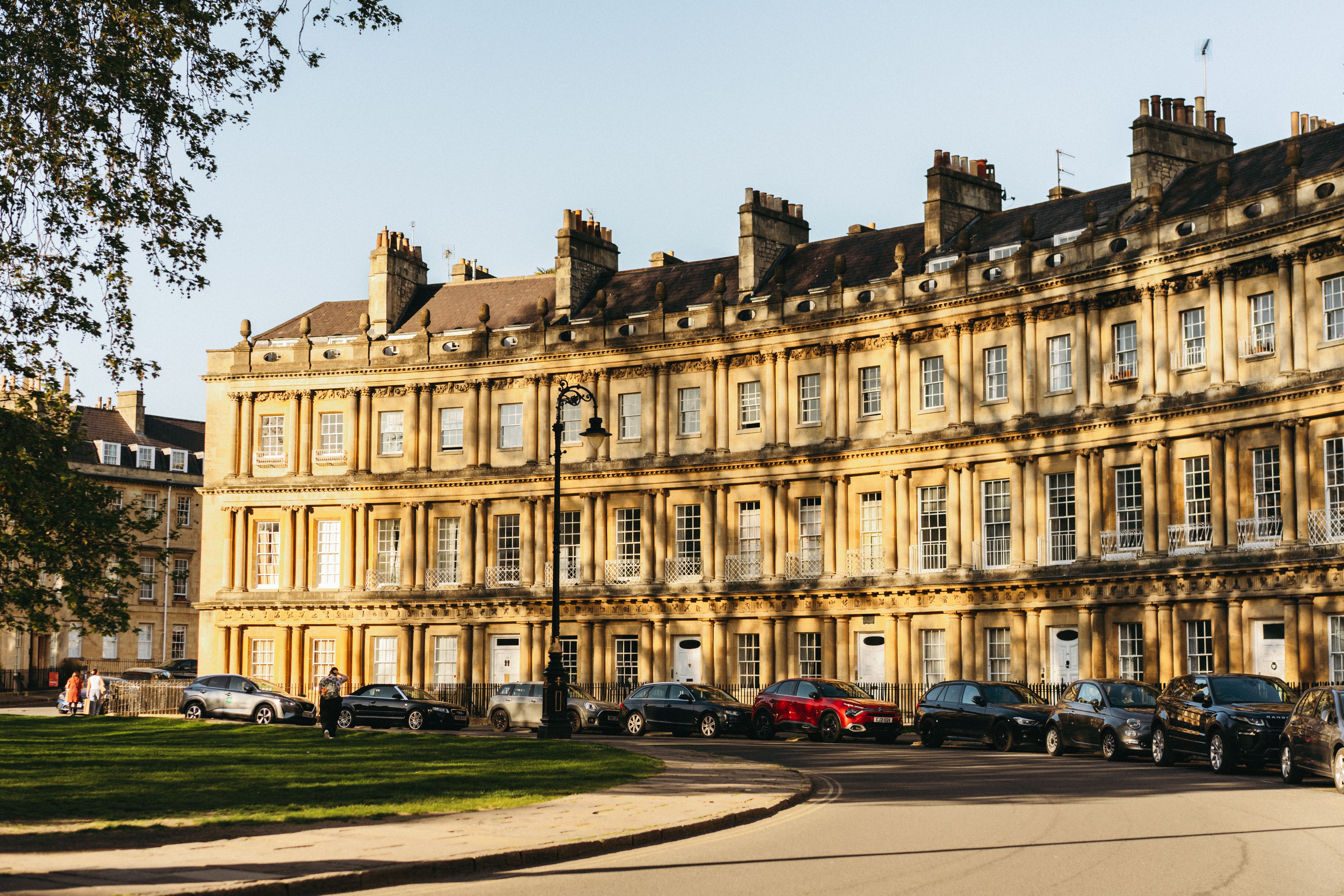
33 Georgian townhouses arranged in a perfect circle. Designed in 1754, same diameter as Stonehenge. Free to visit — public street. Thomas Gainsborough lived here. Connected to the Royal Crescent by a 200-metre walk along Brock Street.
Facts and practical information
About The Circus
What is The Circus?
The Circus is a circular arrangement of 33 Bath stone townhouses in three matching curved segments. Designed by John Wood the Elder in 1754 and completed by his son in 1768, it was an explicitly classical reference — the same diameter as Stonehenge, the same proportions as the Colosseum seen in section. Wood used all three classical orders (Doric, Ionic, Corinthian) on the three tiers of the facade, stacked bottom to top. A continuous frieze of 528 acanthus-leaf symbols runs the full circumference of the first storey — no two are identical.
John Wood's original intention
Wood the Elder was a Freemason and an antiquarian with strong theories about Bath's ancient significance. He believed The Circus had a symbolic connection to Stonehenge (which shares its diameter) and was intended as part of a sequence: King's Circus at the high point of the city, connected via Gay Street to Queen Square below. The circus was a sun symbol; the square was a moon symbol. Whether you find this compelling or eccentric, the result is one of the most perfectly proportioned urban spaces in Britain.
Famous residents
Thomas Gainsborough lived at number 17 from 1760 to 1774 — his most productive Bath period. William Pitt the Elder (Earl of Chatham) lived at number 7. David Livingstone stayed at number 13. The Blue Plaques scheme has marked several of the houses. The Circus is still entirely residential today; none of the houses are open to the public, though you can walk freely around the central garden and street.
Walking the Royal Mile
The standard itinerary connects Gay Street (linking Queen Square to The Circus), The Circus itself, and Brock Street (leading west from The Circus to the Royal Crescent). This walk — Queen Square to Royal Crescent — is approximately 600 metres and covers Bath's three defining Georgian set-pieces in sequence. Allow 20–30 minutes to walk it properly, or 60 minutes if you stop to read all the plaques and look at the facades. No entry fees anywhere on this route.
The Queen Square → Circus → Royal Crescent walk
The 600-metre route from Queen Square via Gay Street to The Circus and on via Brock Street to the Royal Crescent covers Bath's Georgian core in a 20-minute walk. Free, no booking required. Best in late afternoon light.
Guided walking tours of Bath
The best guided tours take in The Circus, the Royal Crescent, and Queen Square in the same 2-hour walk — with the architectural history explained in context.
Bath walking tours →Hotels near The Circus
The Circus is in the upper residential part of Bath — quieter than the centre and 10 minutes from the main attractions on foot. The Queensberry Hotel is a 3-minute walk; The Royal Crescent Hotel is 200 metres along Brock Street.
Hotels near The Circus →The Weekend Five
This weekend's top 5 events, in your inbox Friday
Picked from the live feed. One email a week, no filler.
The Circus, Bath — frequently asked
What is The Circus in Bath?
How do I get to The Circus in Bath?
Is The Circus in Bath free?
Can you go inside The Circus in Bath?
What is the difference between The Circus and the Royal Crescent in Bath?
Is The Circus in Bath used for Bridgerton filming?
Advertisement