Moving to Bath
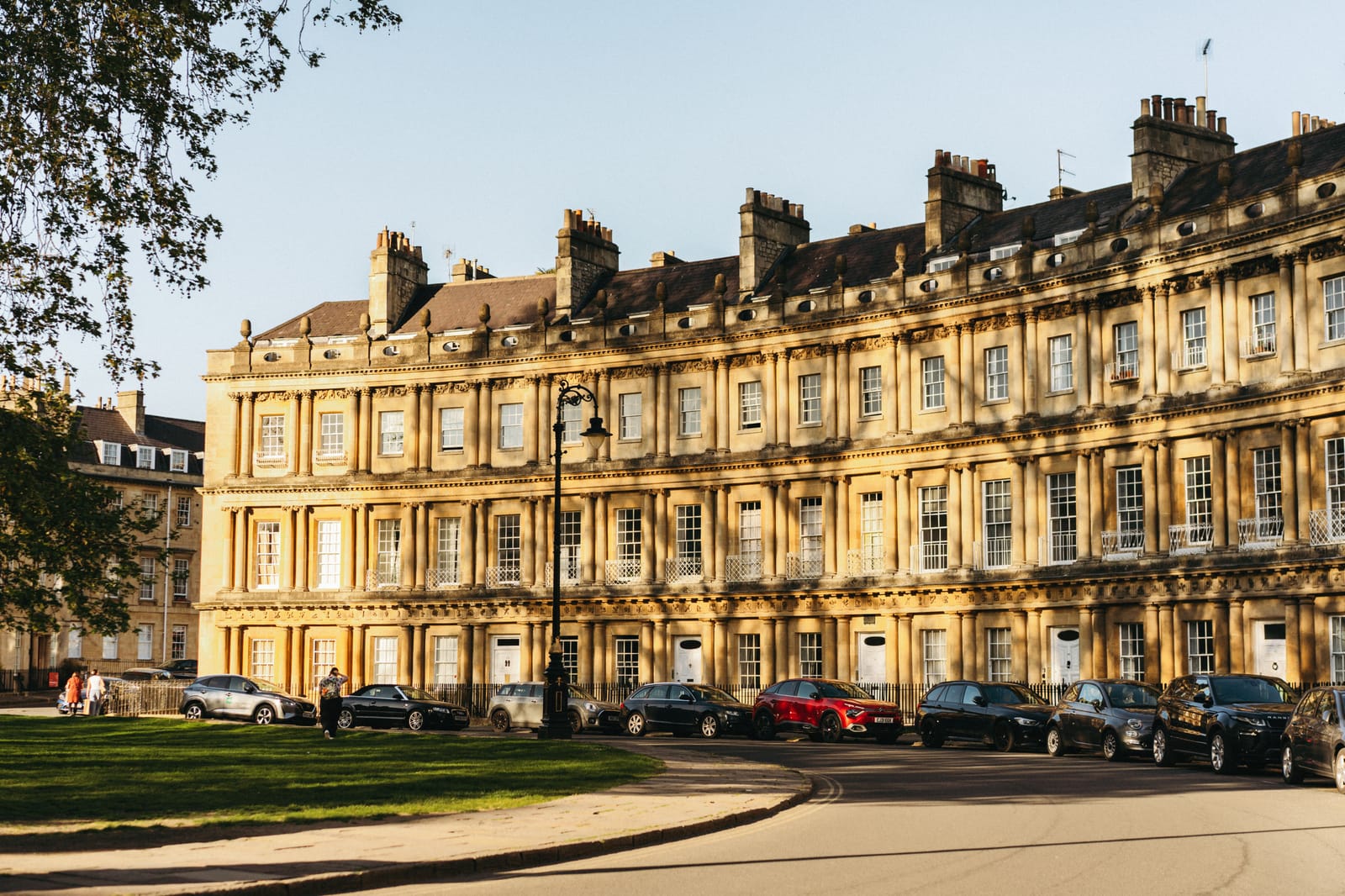
Bath is 84 minutes from London Paddington by direct GWR service. Bristol: 11 minutes. Median house price BA1 (city centre, Larkhall, Lansdown): £465,000. BA2 (Oldfield Park, Bear Flat, Widcombe): £385,000. Average days to let across the city: 22–24. The city is compact — population 93,000 — which means a real centre with independent shops and a functioning cultural life, without the scale that makes large cities difficult to live in day-to-day. The hills are real: most of Bath's residential neighbourhoods sit above the valley floor and the walks are steep. The Georgian architecture is genuine: much of what you see on the postcards is Grade II listed and still occupied. The property market moves quickly, school catchments matter, and the train to London is the city's most important asset. This guide covers all of it.
Key figures for Bath relocation
£465,000
Median house price, BA1
Bath city centre and north
Land Registry, May 2026
£385,000
Median house price, BA2
South Bath and wider area
Land Registry, May 2026
84 min
London Paddington by train
GWR direct from Bath Spa
GWR timetable, June 2026
Why people move to Bath
Most people who move to Bath do so for one of four reasons: schools, rail access, quality of life, or they visited and decided they could not leave. The city is small — population around 93,000 — which means a genuine city centre with independent shops, restaurants, and a cultural offer, without the scale and noise that makes large cities hard to live in day-to-day.
The rail connection to London is the city's single most important economic asset. Bath is close enough to London that professionals can commute two or three days a week without the commute consuming their lives, yet far enough that the city has its own identity and housing prices, while high, are substantially below comparable London zones.
The school question drives a significant proportion of purchases. Bath's grammar stream is competitive, and families relocate specifically to be in catchment for Hayesfield or within the grammar-testing radius. The independent school sector (King Edward's School, Prior Park College, Kingswood School) adds further depth for families considering private education.
For younger professionals, the city's compact size means no car is needed for daily life. The centre is walkable, cycling infrastructure has improved substantially since 2020, and the bus network connects all major residential areas to the centre in under 20 minutes. Bristol is 11 minutes by train — effectively the same labour market.
Getting to and from Bath
- London Paddington 84 min direct (GWR)
- Bristol Temple Meads 11 min direct (GWR)
- Cardiff Central 70 min direct (GWR)
- Bristol Airport (BRS) 45 min by bus or taxi
- London by car (M4/A4) 1hr 45min off-peak
Road access into Bath is consistently difficult. The A36 and A4 corridors into the city centre are among the most congested roads in the South West. Residents who work in Bath itself rarely commute by car; those who commute to Bristol often drive to a Park and Ride and take a bus, or use the direct rail service.
For Bristol Airport connections, the A4 Bristol Road is the standard route. A direct bus from Bath city centre to the airport runs regularly and takes around 45–55 minutes. Taxi is faster in off-peak hours and costs around £35–40 one way.
The property market
Bath's property market is tight. The city's geographic constraints — it sits in a river valley surrounded by hills — limit housing supply, and the combination of strong local employment, university demand, and inbound commuter interest keeps prices firm. Corrections in the wider national market tend to be shallower in Bath than in comparable secondary cities.
BA1 (city centre, Larkhall, Lambridge, and the northern slopes) carries the highest prices. BA2 (south of the river, Oldfield Park, Twerton, Bear Flat, Widcombe) offers better value without giving up much in terms of quality of life or access. Most two-bedroom terraced houses in Oldfield Park trade at £320,000–380,000; comparable properties in Larkhall run £380,000–440,000.
Rental yields are reasonable for a city of this quality: the BA1 average is 4.1% gross; BA2 runs slightly higher at 4.4%, reflecting lower acquisition prices against similar rental demand. Days to let average 22–24 across the city (Land Registry, May 2026).
Schools
Bath is unusual among UK cities its size for the quality of its state school provision. Hayesfield Girls' School operates a selective grammar sixth form and has been rated Outstanding by Ofsted. Ralph Allen School and Beechen Cliff School (boys' comprehensive, Outstanding) are the main secondary comprehensives and perform well above the national average.
At primary level, provision is strong across most of the city. The St Saviour's and Larkhall primaries serve the north; Oldfield Park and Weston serve the south and west. Competition for oversubscribed primaries is real — sibling priority and distance-from-gate criteria dominate. BANES publishes annual admissions data and catchment maps; cross-reference these with any property before exchanging contracts.
Independent options include King Edward's School (selective, co-ed, fees from £17,000 p.a.) and Prior Park College (Catholic, co-ed, fees from £16,500 p.a.), both with strong academic records and active scholarship programmes.
Healthcare
The Royal United Hospital on Combe Park is Bath's main acute hospital — a full-service district general hospital rated 'Good' by the Care Quality Commission (2024). It handles emergency medicine, surgery, maternity, and a range of specialist clinics. Tertiary specialist services — complex oncology, major trauma, specialist cardiac surgery — are referred to Bristol, which is 20 minutes by car and 11 by train.
GP provision is available across the city, with practices in all major residential areas. Registration waits at oversubscribed practices have increased in recent years, consistent with national trends. New residents should register with a GP promptly on arrival rather than waiting until they need an appointment.
Dental provision follows the national pattern: NHS dental appointments can be difficult to secure; private dentists are available throughout the city from around £60 for a standard consultation.
What to expect when you arrive
Bath is a genuinely pleasant city to live in, with the predictable trade-offs of any UK city with a large tourist economy: the centre is crowded in summer, parking is expensive and limited, and retail rents mean the high street has the same chains as everywhere else. The neighbourhoods — Larkhall, Widcombe, Bear Flat, Oldfield Park — are where the quality of life is.
The city's cultural offer is strong relative to its size: the Theatre Royal, Komedia, the Holburne Museum, the Bath Film Festival, and a functioning live music scene centred on the Mission Theatre and the Bell Inn. Bath's restaurant scene has improved significantly since 2020 — there are now several independent restaurants worth the price.
Rain: the river valley location means Bath is wetter than the UK average. Expect fog on winter mornings on the lower streets, and rain on roughly 140 days per year. The surrounding hills and the canal network mean walking and cycling are genuinely good despite this.
Advertisement
The Weekend Five
This weekend's top 5 events, in your inbox Friday
Picked from the live feed. One email a week, no filler.
Moving to Bath — common questions
Is Bath an expensive place to live?
What are the best areas to live in Bath?
How good are the schools in Bath?
How is healthcare in Bath?
What is commuting from Bath like?
Advertisement