Jane Austen in Bath
Jane Austen lived in Bath from 1801 to 1806 — five years she found difficult but which produced two novels with Bath at their centre. Northanger Abbey uses Bath's social season as its scaffolding; Persuasion uses Bath's class-consciousness as its subject. The streets Austen walked are still largely intact: Gay Street, the Assembly Rooms, Pulteney Bridge, Sydney Gardens. The Jane Austen Centre on Gay Street tells the story in detail. The rest of the city tells it in stone.
£14
Jane Austen Centre admission
Adults. Children from £7.50
Jane Austen Centre, 2026
1801–1806
Austen's Bath years
4 addresses across the city
Austen biographies
2
Novels set in Bath
Northanger Abbey, Persuasion
Jane Austen
Jane Austen sites in Bath
Jane Austen Centre
40 Gay Street, Bath BA1 2NT
Daily 9:45–17:30 (last entry 17:00). Extended hours in summer. · Adults £14. Children (6–16) £7.50. Under-6s free.
The dedicated Jane Austen museum in a Georgian townhouse on Gay Street, one of the streets Austen herself walked regularly. The museum covers Austen's two Bath residences, her relationship with the city, and the role Bath plays in Northanger Abbey and Persuasion. The costumed interpreters and Regency tea room are popular; the exhibition is modest in size but well-curated. Worth 45–60 minutes. The tea room serves Regency-style food and is open to non-museum visitors.
Note: Gay Street runs between The Circus and Queen Square — Austen walked it regularly during her Bath years.
4 Sydney Place (Austen's residence)
4 Sydney Place, Bath BA2 6NE
Private residence — exterior only · Free (exterior view only)
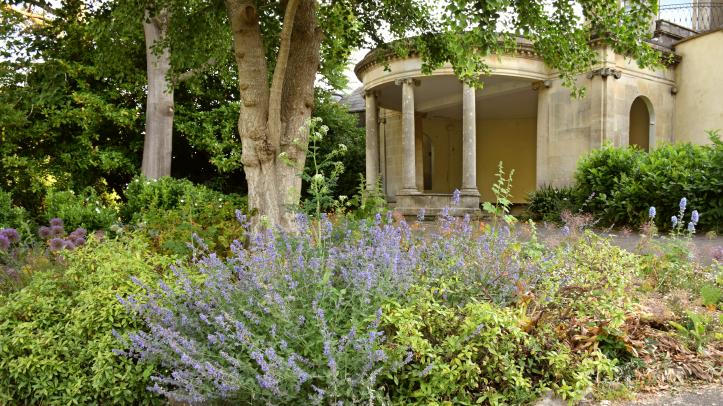
The Austen family's first and longest Bath residence (1801–1804), on the east side of Sydney Gardens. A blue plaque marks the house. Sydney Gardens — now a public park with the Kennet and Avon Canal running through it — was one of the few outdoor spaces Austen wrote positively about in her Bath letters. The garden was, in Austen's time, a pleasure garden with fireworks and concerts.
Note: Best combined with a walk through Sydney Gardens to the Holburne Museum — Austen would have walked this route regularly.
1 Paragon (uncle's residence)
1 Paragon, Bath BA1 5LR
Private residence — exterior only · Free
The Austen family's first exposure to Bath was through visits to Jane's uncle, the Rev. Edward Cooper, at 1 Paragon. The family stayed here before taking their own residences. The Paragon is a Georgian terrace above the city on the hill toward Lansdown.
Note: A short walk from the Assembly Rooms and The Circus.
The Assembly Rooms
Bennett Street, Bath BA1 2QH
Currently closed for renovation (reopening 2027) · Currently closed to visitors
The Assembly Rooms — where Bath's Georgian society gathered for balls, concerts, and card playing — are central to Northanger Abbey and Persuasion. Catherine Morland dances here; Anne Elliot and Captain Wentworth's reunion culminates here. The Rooms are currently undergoing major renovation ahead of their 2027 reopening. Exterior photography is possible. The Fashion Museum that was at the same address closed in 2022 and is not expected to reopen, in a new New Bond Street home, until around 2030.
Note: Plan to visit after the 2027 reopening for the interior — the ballroom is the key Austen space in Bath.
Pulteney Bridge and Pulteney Street
Pulteney Bridge, Bath BA2 4AX
Public — always accessible · Free
Bath's elegant Palladian bridge and the broad street beyond it (Great Pulteney Street) are the physical heart of Northanger Abbey. The bridge and the streets around it were new in Austen's time and represented the expanding fashionable Bath she wrote about. Great Pulteney Street leads to the Holburne Museum (Bridgerton's Lady Danbury house; in Austen's time, Sydney Hotel).
Note: Walk from Pulteney Bridge along Great Pulteney Street to Sydney Gardens for the full Austen-era spatial sequence.
Bath in Austen's novels
Northanger Abbey
Written 1798–1799, published 1817 (posthumously)
Bath is the primary setting for the first half of the novel. Catherine Morland visits Bath with the Allens; the Assembly Rooms, Pump Room, and Milsom Street shopping are central to the plot. The novel uses Bath's social season structure as the scaffolding for the story.
Persuasion
Written 1815–1816, published 1817 (posthumously)
Bath is the setting for the second half. Sir Walter Elliot moves his family to Bath for economy. The novel contains Austen's most direct commentary on Bath's social stratification — which Austen, having lived there, understood precisely. The Assembly Rooms appear in the climactic scenes.
Why Bath matters to Austen
Austen's Bath was not the heritage city it is today — it was a working resort at the height of its fashionable period, where middle-class families went to cure real or imagined ailments, find marriage partners, and perform their social standing. The Pump Room, Assembly Rooms, and circulating libraries on Milsom Street were the infrastructure of that social economy. Austen used them in her fiction with the precision of someone who had experienced them personally and found them both fascinating and absurd. The Bath of Northanger Abbey is naive; the Bath of Persuasion, written fifteen years later after the city had already begun its decline as a resort, is considerably sharper.
The Weekend Five
This weekend's top 5 events, in your inbox Friday
Picked from the live feed. One email a week, no filler.
Frequently asked questions
Did Jane Austen live in Bath?
What is the Jane Austen Centre in Bath?
Which Jane Austen novels are set in Bath?
Can you do a Jane Austen walking tour of Bath?
Where did Jane Austen stay in Bath?
Advertisement